
Loss of Smell in Parkinson’s: Hyposmia Causes, Symptoms & Daily Life Impact
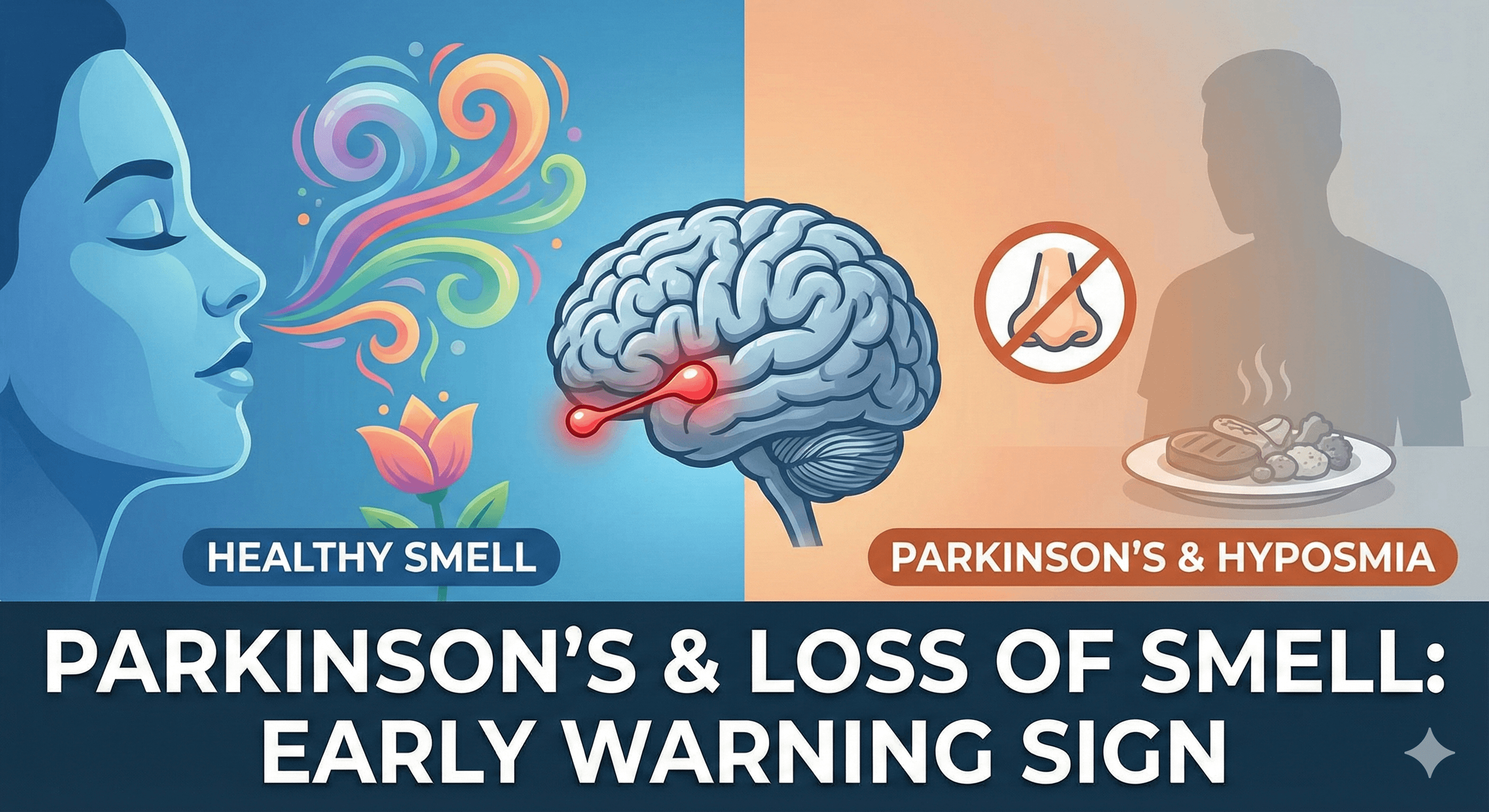
Loss of smell, or Hyposmia, is one of the earliest and most common non-motor symptoms of Parkinson’s Disease (PD), often appearing years or even decades before motor symptoms like tremors. It occurs because the olfactory bulb (the smell center in the brain) is one of the first areas damaged by Lewy bodies. While it doesn't cause physical pain, it significantly impacts appetite, safety, and quality of life.
The Canary in the Coal Mine
For a long time, Parkinson's was thought of purely as a movement disorder. We now know it is a systemic disease. The loss of the sense of smell is often the very first sign, serving as a "canary in the coal mine." Studies show that up to 90% of people with PD have some degree of smell loss.
Why Does It Happen?
The pathology of Parkinson's involves the accumulation of a protein called alpha-synuclein into clumps known as Lewy bodies.
Staging: According to the Braak Staging hypothesis, these clumps start in the olfactory bulb (smell) and the gut nerve plexus before spreading to the brainstem (movement) and eventually the cortex (thinking).
Result: This is why smell loss and constipation often predate the tremor by years.
Impact on Daily Life
Losing the ability to smell is more than just an annoyance; it has real-world consequences.
1. Safety Hazards
Gas Leaks: Inability to smell a gas leak or smoke can be dangerous.
Spoiled Food: Difficulty detecting if milk has gone sour or meat is rotten.
2. Appetite and Nutrition
Flavor is mostly smell: Our tongue only tastes sweet, salty, sour, bitter, and umami. The complex "flavor" of food comes from its aroma.
Weight Loss: When food tastes bland (like cardboard), patients lose interest in eating, leading to unintended weight loss and malnutrition.
3. Emotional Well-being
Memory Links: Smells are strongly linked to memory and emotion (e.g., the smell of rain, a partner's perfume). Losing this disconnects people from these emotional triggers.
Diagnosis and Testing
Sniff Sticks: Doctors use standardized "scratch and sniff" tests (like the UPSIT) to measure olfactory function.
Differential Diagnosis: It helps distinguish PD from other conditions. For example, smell loss is common in PD but rare in Progressive Supranuclear Palsy (PSP) or Corticobasal Degeneration (CBD).
COVID-19 Note: Sudden smell loss is also a symptom of COVID-19. In PD, the loss is usually gradual and unnoticed until tested.
Management Strategies
There is currently no cure for smell loss in PD, but you can manage the consequences.
1. Safety Measures
Detectors: Install high-quality smoke and carbon monoxide detectors.
Food Safety: Check expiration dates religiously. Ask a family member to "sniff test" leftovers.
2. Enhancing Food
Texture and Spice: Since flavor is muted, focus on the texture (crunchy, creamy) and taste (spicy, sour, salty) of food to make eating enjoyable.
Visual Appeal: Make food look colorful and appetizing.
Key Takeaways
It's not just aging: While smell fades with age, the loss in PD is more severe and specific.
Early warning: If you have lost your sense of smell and have a family history of PD, monitor for other signs.
You're not imagining it: Many patients complain food tastes bland long before they are diagnosed.
Safety first: Rely on technology (alarms) and others for safety checks.
FAQ
Q: Will my smell ever come back?
A: Unfortunately, in Parkinson's, the loss is usually permanent and progressive.
Q: Does everyone with smell loss get Parkinson's?
A: No. Smell loss can be caused by sinus issues, viruses, head injury, or normal aging. However, unexplained smell loss is a significant risk factor.
Q: Can I train my nose to smell again?
A: Olfactory training (sniffing essential oils daily) helps some people with viral smell loss, but its effectiveness in Parkinson's is limited.
Loss of smell, or Hyposmia, is one of the earliest and most common non-motor symptoms of Parkinson’s Disease (PD), often appearing years or even decades before motor symptoms like tremors. It occurs because the olfactory bulb (the smell center in the brain) is one of the first areas damaged by Lewy bodies. While it doesn't cause physical pain, it significantly impacts appetite, safety, and quality of life.
The Canary in the Coal Mine
For a long time, Parkinson's was thought of purely as a movement disorder. We now know it is a systemic disease. The loss of the sense of smell is often the very first sign, serving as a "canary in the coal mine." Studies show that up to 90% of people with PD have some degree of smell loss.
Why Does It Happen?
The pathology of Parkinson's involves the accumulation of a protein called alpha-synuclein into clumps known as Lewy bodies.
Staging: According to the Braak Staging hypothesis, these clumps start in the olfactory bulb (smell) and the gut nerve plexus before spreading to the brainstem (movement) and eventually the cortex (thinking).
Result: This is why smell loss and constipation often predate the tremor by years.
Impact on Daily Life
Losing the ability to smell is more than just an annoyance; it has real-world consequences.
1. Safety Hazards
Gas Leaks: Inability to smell a gas leak or smoke can be dangerous.
Spoiled Food: Difficulty detecting if milk has gone sour or meat is rotten.
2. Appetite and Nutrition
Flavor is mostly smell: Our tongue only tastes sweet, salty, sour, bitter, and umami. The complex "flavor" of food comes from its aroma.
Weight Loss: When food tastes bland (like cardboard), patients lose interest in eating, leading to unintended weight loss and malnutrition.
3. Emotional Well-being
Memory Links: Smells are strongly linked to memory and emotion (e.g., the smell of rain, a partner's perfume). Losing this disconnects people from these emotional triggers.
Diagnosis and Testing
Sniff Sticks: Doctors use standardized "scratch and sniff" tests (like the UPSIT) to measure olfactory function.
Differential Diagnosis: It helps distinguish PD from other conditions. For example, smell loss is common in PD but rare in Progressive Supranuclear Palsy (PSP) or Corticobasal Degeneration (CBD).
COVID-19 Note: Sudden smell loss is also a symptom of COVID-19. In PD, the loss is usually gradual and unnoticed until tested.
Management Strategies
There is currently no cure for smell loss in PD, but you can manage the consequences.
1. Safety Measures
Detectors: Install high-quality smoke and carbon monoxide detectors.
Food Safety: Check expiration dates religiously. Ask a family member to "sniff test" leftovers.
2. Enhancing Food
Texture and Spice: Since flavor is muted, focus on the texture (crunchy, creamy) and taste (spicy, sour, salty) of food to make eating enjoyable.
Visual Appeal: Make food look colorful and appetizing.
Key Takeaways
It's not just aging: While smell fades with age, the loss in PD is more severe and specific.
Early warning: If you have lost your sense of smell and have a family history of PD, monitor for other signs.
You're not imagining it: Many patients complain food tastes bland long before they are diagnosed.
Safety first: Rely on technology (alarms) and others for safety checks.
FAQ
Q: Will my smell ever come back?
A: Unfortunately, in Parkinson's, the loss is usually permanent and progressive.
Q: Does everyone with smell loss get Parkinson's?
A: No. Smell loss can be caused by sinus issues, viruses, head injury, or normal aging. However, unexplained smell loss is a significant risk factor.
Q: Can I train my nose to smell again?
A: Olfactory training (sniffing essential oils daily) helps some people with viral smell loss, but its effectiveness in Parkinson's is limited.
ಚಂದಾ ನಮ್ಮ ನ್ಯೂಸ್ಲೆಟರ್ ಗೆ
