
Parkinsonism Explained: Types, Causes & How It Differs From Parkinson’s Disease
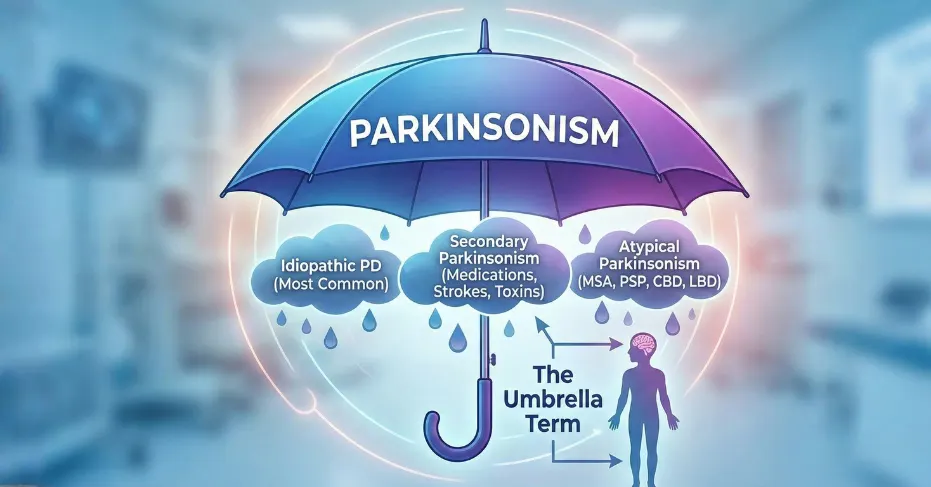
"Parkinsonism" is not a single disease but a clinical syndrome—a collection of symptoms. It refers to any condition that shares the cardinal features of Parkinson’s Disease: tremor, bradykinesia (slowness), rigidity, and postural instability. While Idiopathic Parkinson’s Disease is the most common cause, Parkinsonism can also be caused by medications, strokes, toxins, or other neurodegenerative disorders (Atypical Parkinsonism). Identifying the root cause is essential for effective treatment.
The Umbrella Term
Think of "Parkinsonism" as an umbrella. Under this umbrella sit many different conditions.
Idiopathic Parkinson’s Disease (PD): Accounts for ~85% of cases.
Secondary Parkinsonism: Caused by external factors.
Atypical Parkinsonism (Parkinson-Plus): Rare, progressive brain disorders.
1. Secondary Parkinsonism (The "Reversible" Types)
Sometimes, Parkinsonism is a side effect or a result of damage, not a progressive disease.
Drug-Induced Parkinsonism (DIP): The most common secondary cause. Certain medications block dopamine receptors.
Culprits: Antipsychotics (Haldol), anti-nausea meds (Metoclopramide), and some calcium channel blockers.
Good News: Symptoms usually disappear when the drug is stopped.
Vascular Parkinsonism: Caused by multiple small strokes (lacunar infarcts) in the brain's deep structures.
Key Sign: "Lower body Parkinsonism"—shuffling gait but good upper body function.
Toxin-Induced: Exposure to manganese, carbon monoxide, or certain pesticides (MPTP).
2. Atypical Parkinsonism (The "Plus" Syndromes)
These mimic PD but have additional symptoms ("Plus") and a poorer prognosis.
Multiple System Atrophy (MSA): Parkinsonism + Autonomic failure (fainting, incontinence).
Progressive Supranuclear Palsy (PSP): Parkinsonism + Eye movement trouble + Early falls.
Corticobasal Degeneration (CBD): Parkinsonism + Alien limb phenomenon + Apraxia.
Lewy Body Dementia (LBD): Parkinsonism + Early dementia + Visual hallucinations.
Diagnosis: The Detective Work
Distinguishing between these types is difficult, especially in the early stages.
Response to Levodopa: This is the biggest clue. Idiopathic PD responds well. Vascular and Atypical forms usually respond poorly or not at all.
Symmetry: PD usually starts on one side. Drug-induced and Vascular forms are often symmetrical (affecting both sides equally).
Progression: Atypical forms progress much faster than standard PD.
Imaging: MRI can show strokes (Vascular) or specific atrophy patterns (Atypical). DaTscan confirms dopamine loss but doesn't specify the type.
Management
For Drug-Induced: Stop the offending medication.
For Vascular: Control blood pressure, cholesterol, and prevent future strokes. Physical therapy is the main treatment.
For Atypical: Symptomatic relief. Levodopa is tried but often discontinued if ineffective. Focus shifts to therapy, safety, and palliative care.
Key Takeaways
Review your meds: If you develop tremors, check if any of your current medications are to blame.
Not all shakes are PD: A thorough history is needed to rule out other causes.
Vascular health matters: Controlling heart health can prevent Vascular Parkinsonism.
Get a specialist: A general practitioner may miss the subtle signs of Atypical Parkinsonism. See a Movement Disorder Specialist.
FAQ
Q: Is Parkinsonism curable?
A: Drug-induced Parkinsonism is often curable. Other forms are chronic, but symptoms can be managed.
Q: Can a head injury cause Parkinsonism?
A: Yes, "Pugilistic Parkinsonism" (seen in boxers like Muhammad Ali) is caused by repeated head trauma.
Q: How do I know if it's Vascular or regular PD?
A: Vascular patients often have a history of high blood pressure or strokes, and their walking is worse than their hand movement.
"Parkinsonism" is not a single disease but a clinical syndrome—a collection of symptoms. It refers to any condition that shares the cardinal features of Parkinson’s Disease: tremor, bradykinesia (slowness), rigidity, and postural instability. While Idiopathic Parkinson’s Disease is the most common cause, Parkinsonism can also be caused by medications, strokes, toxins, or other neurodegenerative disorders (Atypical Parkinsonism). Identifying the root cause is essential for effective treatment.
The Umbrella Term
Think of "Parkinsonism" as an umbrella. Under this umbrella sit many different conditions.
Idiopathic Parkinson’s Disease (PD): Accounts for ~85% of cases.
Secondary Parkinsonism: Caused by external factors.
Atypical Parkinsonism (Parkinson-Plus): Rare, progressive brain disorders.
1. Secondary Parkinsonism (The "Reversible" Types)
Sometimes, Parkinsonism is a side effect or a result of damage, not a progressive disease.
Drug-Induced Parkinsonism (DIP): The most common secondary cause. Certain medications block dopamine receptors.
Culprits: Antipsychotics (Haldol), anti-nausea meds (Metoclopramide), and some calcium channel blockers.
Good News: Symptoms usually disappear when the drug is stopped.
Vascular Parkinsonism: Caused by multiple small strokes (lacunar infarcts) in the brain's deep structures.
Key Sign: "Lower body Parkinsonism"—shuffling gait but good upper body function.
Toxin-Induced: Exposure to manganese, carbon monoxide, or certain pesticides (MPTP).
2. Atypical Parkinsonism (The "Plus" Syndromes)
These mimic PD but have additional symptoms ("Plus") and a poorer prognosis.
Multiple System Atrophy (MSA): Parkinsonism + Autonomic failure (fainting, incontinence).
Progressive Supranuclear Palsy (PSP): Parkinsonism + Eye movement trouble + Early falls.
Corticobasal Degeneration (CBD): Parkinsonism + Alien limb phenomenon + Apraxia.
Lewy Body Dementia (LBD): Parkinsonism + Early dementia + Visual hallucinations.
Diagnosis: The Detective Work
Distinguishing between these types is difficult, especially in the early stages.
Response to Levodopa: This is the biggest clue. Idiopathic PD responds well. Vascular and Atypical forms usually respond poorly or not at all.
Symmetry: PD usually starts on one side. Drug-induced and Vascular forms are often symmetrical (affecting both sides equally).
Progression: Atypical forms progress much faster than standard PD.
Imaging: MRI can show strokes (Vascular) or specific atrophy patterns (Atypical). DaTscan confirms dopamine loss but doesn't specify the type.
Management
For Drug-Induced: Stop the offending medication.
For Vascular: Control blood pressure, cholesterol, and prevent future strokes. Physical therapy is the main treatment.
For Atypical: Symptomatic relief. Levodopa is tried but often discontinued if ineffective. Focus shifts to therapy, safety, and palliative care.
Key Takeaways
Review your meds: If you develop tremors, check if any of your current medications are to blame.
Not all shakes are PD: A thorough history is needed to rule out other causes.
Vascular health matters: Controlling heart health can prevent Vascular Parkinsonism.
Get a specialist: A general practitioner may miss the subtle signs of Atypical Parkinsonism. See a Movement Disorder Specialist.
FAQ
Q: Is Parkinsonism curable?
A: Drug-induced Parkinsonism is often curable. Other forms are chronic, but symptoms can be managed.
Q: Can a head injury cause Parkinsonism?
A: Yes, "Pugilistic Parkinsonism" (seen in boxers like Muhammad Ali) is caused by repeated head trauma.
Q: How do I know if it's Vascular or regular PD?
A: Vascular patients often have a history of high blood pressure or strokes, and their walking is worse than their hand movement.
ಚಂದಾ ನಮ್ಮ ನ್ಯೂಸ್ಲೆಟರ್ ಗೆ
