
Signs of Stroke in Adults: BEFAST Symptoms & Brain Attack Warning Signs
The human brain is a marvel of biological engineering, demanding a constant, uninterrupted supply of oxygen and nutrients to function. When that supply is cut off, even for a moment, the consequences can be catastrophic. In the medical community, we increasingly refer to a stroke as a "brain attack." This terminology isn’t just a rebranding; it is a deliberate effort to convey urgency. Just as a heart attack requires immediate intervention to save the heart muscle, a brain attack requires split-second action to save the mind.
Recognizing the signs of stroke in adults is not merely a medical skill—it is a life-saving necessity. Stroke remains a leading cause of disability and death globally, yet a vast number of victims arrive at the hospital outside the "golden window" for treatment. The tragedy of stroke is often not the event itself, but the delay in recognition.
This guide explores the anatomy of a brain attack, dissects the critical symptoms using the BEFAST protocol, and highlights the subtle, often ignored warning signs that every adult should know.
Understanding the Anatomy of a "Brain Attack"
To recognize the enemy, one must understand how it operates. A stroke occurs when the blood supply to part of your brain is interrupted or reduced, preventing brain tissue from getting oxygen and nutrients. Brain cells begin to die in minutes.
There are two primary ways this happens, and understanding the difference helps distinct the severity of the situation:
Ischemic Stroke: This is the most common form, accounting for roughly 87% of all cases. Think of this as a plumbing clog. A blood clot forms—either in the brain or traveling from elsewhere in the body—and blocks a vessel supplying blood to the brain.
Hemorrhagic Stroke: This is akin to a plumbing leak or burst pipe. A blood vessel in the brain leaks or ruptures, causing blood to spill into the surrounding tissue. This not only deprives cells of oxygen but also creates immense pressure within the skull.
Regardless of the type, the result is the same: rapid loss of neurological function. The visible signs of stroke in adults are the direct physical manifestations of parts of the brain going offline.
The Concept of "Time is Brain"
In neurology, there is a maxim that guides every emergency protocol: Time is Brain.
Research indicates that in a typical ischemic stroke, the average patient loses 1.9 million neurons, 14 billion synapses, and 7.5 miles of myelinated fibers every minute the stroke goes untreated. In terms of brain aging, every hour without treatment is equivalent to aging the brain by 3.6 years.
This leads to the crucial concept of the "Golden Hour." The Golden Hour refers to the critical 60-minute window following the onset of stroke symptoms. Receiving specialized medical treatment within this first hour offers the highest probability of restoring blood flow and saving brain tissue, significantly reducing the risk of long-term disability. Every minute that passes after this window closes slowly diminishes the effectiveness of intervention.
This is why recognizing brain attack symptoms early is the single most significant factor in recovery. Modern medicine offers miracle drugs like tPA (tissue plasminogen activator) and procedures like thrombectomy that can dissolve or remove clots. However, these treatments have a strict time limit. If you wait to see if the symptoms "pass," you are likely waiting until the damage is permanent.
The Gold Standard: The BEFAST Protocol
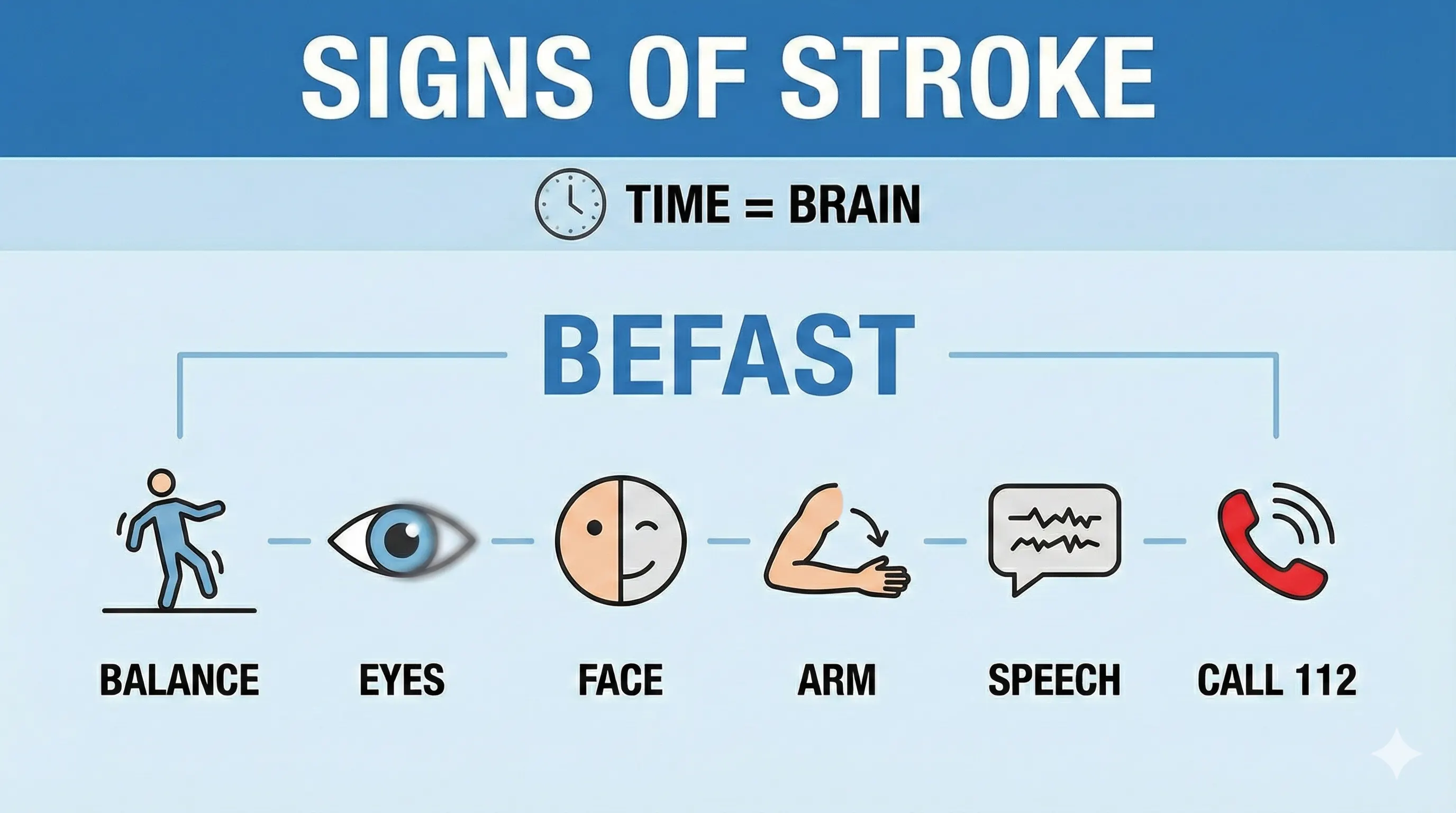
For decades, the medical community utilized the FAST acronym. However, to capture more symptoms and improve detection rates, the protocol has been updated to BEFAST. It remains the most effective tool for rapid identification. If you suspect someone is having a brain attack, conduct this multi-step test immediately:
B: Balance
Sudden vertigo, stumbling, or a loss of coordination can be a sign of stroke, particularly in the back of the brain. If a person suddenly cannot walk straight or feels like the room is spinning without an inner-ear cause, this requires immediate evaluation.
E: Eyes
A stroke can disrupt the pathway between the eyes and the brain's visual processing center. The victim might experience sudden blurred vision, blackened vision in one or both eyes, or double vision (diplopia). A common description is a "curtain" falling over one eye.
F: Face Drooping
Ask the person to smile. This simple social cue is a complex motor function. During a stroke, muscle weakness or paralysis on one side of the face causes the smile to appear uneven. One side of the mouth may droop, or the eyelid on that side may look heavy. If the smile isn't symmetrical, it is a red flag.
A: Arm Weakness
Ask the person to raise both arms. Stroke often affects one hemisphere of the brain, leading to weakness on the opposite side of the body. In a stroke scenario, one arm may drift downward involuntarily, or the person may be unable to lift it at all. It’s not just about strength; it’s about coordination.
S: Speech Difficulty
Engage the person in conversation. Ask them to repeat a simple phrase, such as "The sky is blue." Listen closely. Is their speech slurred? Do they sound like they have a thick tongue? Or, perhaps more frighteningly, are they unable to speak at all despite looking awake? Sometimes, the person may speak clearly but say words that make no sense (aphasia), indicating the stroke is affecting the language centers of the brain.
T: Time to Call Emergency Services
If you observe any of these signs—even if they seem to fluctuate or disappear—call emergency services immediately. Do not drive the person to the hospital yourself unless absolutely necessary. Paramedics can begin life-saving protocols in the ambulance and alert the hospital to prepare a stroke team, saving precious minutes upon arrival.
Beyond BEFAST: The Subtle and Sudden Signs
While BEFAST covers the most common symptoms, signs of stroke in adults can manifest in more complex ways depending on which part of the brain is under attack. A stroke in the cerebellum looks very different from a stroke in the temporal lobe.
1. Sudden Confusion or Trouble Understanding
You might be talking to a loved one, and suddenly they look bewildered. They might be unable to follow a conversation or struggle to comprehend simple instructions. This cognitive fog strikes instantly—it is not a gradual decline like dementia.
2. Sudden Severe Headache
While headaches are common, a "thunderclap" headache—often described as the worst headache of one’s life—can be a sign of a hemorrhagic stroke. This pain hits within seconds and may be accompanied by vomiting, dizziness, or altered consciousness.
Gender Differences: Stroke Symptoms in Women
It is a dangerous misconception that stroke affects men and women identically. While the core signs (BEFAST) apply to everyone, women often report "non-traditional" symptoms that can lead to misdiagnosis or delay in treatment. Because these symptoms can mimic other ailments like the flu or exhaustion, they are easily dismissed.
Women should be vigilant for:
General Weakness: Instead of one-sided paralysis, women may experience profound, sudden fatigue or generalized weakness.
Nausea and Vomiting: Often mistaken for a stomach bug or food poisoning.
Pain: Sudden pain in the face or limbs.
Shortness of Breath: Sudden respiratory struggle without chest pain.
Hiccups: Persistent, unexplainable hiccups can sometimes signal a stroke affecting the brainstem.
Recognizing brain attack symptoms in women often requires looking at the context. If these vague symptoms appear suddenly and severely, assume the worst and seek help.
The Warning Shot: Transient Ischemic Attack (TIA)
Sometimes, the body offers a terrifying preview of what is to come. A Transient Ischemic Attack (TIA), often called a "mini-stroke," presents the exact same symptoms as a full stroke—facial drooping, arm weakness, slurred speech—but the blockage is temporary. The clot dissolves or moves on its own, and symptoms may disappear in a few minutes or hours.
This is the most dangerous moment in stroke prevention.
Many adults experience a TIA, recover quickly, and decide to "sleep it off" or wait for a doctor's appointment next week. This is a critical error. A TIA is a warning shot. It signifies that the conditions for a major stroke are present. Statistics show that about 1 in 3 people who have a TIA will eventually have a stroke, with about half occurring within a year of the TIA.
If symptoms appear and then vanish, you must still go to the emergency room. Medical intervention after a TIA can identify the cause (such as a narrowed carotid artery) and prevent the "Big One" from occurring.
Risk Factors: Are You Vulnerable?
Recognizing the signs is reactive; managing risk is proactive. While age and family history are non-modifiable, the vast majority of strokes are driven by lifestyle factors.
High Blood Pressure (Hypertension): This is the single biggest culprit. Chronic high pressure damages arterial walls, making them prone to blockage or rupture.
Smoking: Chemicals in tobacco thicken the blood and increase plaque buildup in arteries.
Diabetes: High blood sugar damages blood vessels over time.
High Cholesterol: Excess cholesterol creates the waxy plaque that leads to blockages.
Obesity: Excessive body weight puts significant strain on the entire circulatory system. It is closely linked to other risk factors like hypertension, diabetes, and heart disease, effectively multiplying the risk of a stroke.
What to Do (and What Not to Do) While Waiting for Help
If you have identified signs of stroke in adults, your role transitions from observer to first responder. Once you have called emergency services, follow these guidelines:
DO:
Note the time the symptoms started. The "Last Known Well" time is the most critical piece of information for the neurology team. It dictates whether the patient is eligible for clot-busting drugs.
Keep the person calm and still.
Loosen restrictive clothing (ties, scarves, belts) to assist breathing.
Turn them on their side if they are vomiting to prevent choking.
DON’T:
Do not give them aspirin. While aspirin helps heart attacks, if the person is having a hemorrhagic stroke (bleeding), aspirin will thin the blood and make the bleeding worse. You cannot know the stroke type without a CT scan.
Do not give them food or water. Stroke often paralyzes the throat muscles. Giving water can cause aspiration pneumonia.
Do not let them sleep. Keep them awake and engaged until help arrives.
Conclusion: Awareness is the Cure
A brain attack does not announce itself with weeks of pain; it arrives in a split second, altering lives instantaneously. However, the narrative of stroke is changing. It is no longer a hopeless diagnosis. With advancements in neurology and emergency care, survival and recovery rates are higher than ever—but only if the patient gets to the hospital in time.
Recognizing brain attack symptoms early is a responsibility we all share. It requires vigilance, knowledge of the BEFAST protocol, and the courage to act immediately, even if you aren't 100% sure. By familiarizing yourself with these signs of stroke in adults, you become the first line of defense, safeguarding the memories, mobility, and future of the people you love.
Remember: When it comes to stroke, hesitation is the enemy. Speed is the solution.
Frequently Asked Questions
Q: Can a stroke happen without pain? A: Yes. In fact, most ischemic strokes are painless. Do not wait for pain to validate the seriousness of the symptoms.
Q: Can young adults have strokes? A: Absolutely. While risk increases with age, strokes can happen to anyone at any age, often due to unknown congenital heart defects, clotting disorders, or neck injuries.
Q: What is the window for treatment? A: The ideal window for IV clot-busting medication is usually within 3 to 4.5 hours of symptom onset. Mechanical clot removal can sometimes be performed up to 24 hours later, but efficacy decreases with every passing minute.
The human brain is a marvel of biological engineering, demanding a constant, uninterrupted supply of oxygen and nutrients to function. When that supply is cut off, even for a moment, the consequences can be catastrophic. In the medical community, we increasingly refer to a stroke as a "brain attack." This terminology isn’t just a rebranding; it is a deliberate effort to convey urgency. Just as a heart attack requires immediate intervention to save the heart muscle, a brain attack requires split-second action to save the mind.
Recognizing the signs of stroke in adults is not merely a medical skill—it is a life-saving necessity. Stroke remains a leading cause of disability and death globally, yet a vast number of victims arrive at the hospital outside the "golden window" for treatment. The tragedy of stroke is often not the event itself, but the delay in recognition.
This guide explores the anatomy of a brain attack, dissects the critical symptoms using the BEFAST protocol, and highlights the subtle, often ignored warning signs that every adult should know.
Understanding the Anatomy of a "Brain Attack"
To recognize the enemy, one must understand how it operates. A stroke occurs when the blood supply to part of your brain is interrupted or reduced, preventing brain tissue from getting oxygen and nutrients. Brain cells begin to die in minutes.
There are two primary ways this happens, and understanding the difference helps distinct the severity of the situation:
Ischemic Stroke: This is the most common form, accounting for roughly 87% of all cases. Think of this as a plumbing clog. A blood clot forms—either in the brain or traveling from elsewhere in the body—and blocks a vessel supplying blood to the brain.
Hemorrhagic Stroke: This is akin to a plumbing leak or burst pipe. A blood vessel in the brain leaks or ruptures, causing blood to spill into the surrounding tissue. This not only deprives cells of oxygen but also creates immense pressure within the skull.
Regardless of the type, the result is the same: rapid loss of neurological function. The visible signs of stroke in adults are the direct physical manifestations of parts of the brain going offline.
The Concept of "Time is Brain"
In neurology, there is a maxim that guides every emergency protocol: Time is Brain.
Research indicates that in a typical ischemic stroke, the average patient loses 1.9 million neurons, 14 billion synapses, and 7.5 miles of myelinated fibers every minute the stroke goes untreated. In terms of brain aging, every hour without treatment is equivalent to aging the brain by 3.6 years.
This leads to the crucial concept of the "Golden Hour." The Golden Hour refers to the critical 60-minute window following the onset of stroke symptoms. Receiving specialized medical treatment within this first hour offers the highest probability of restoring blood flow and saving brain tissue, significantly reducing the risk of long-term disability. Every minute that passes after this window closes slowly diminishes the effectiveness of intervention.
This is why recognizing brain attack symptoms early is the single most significant factor in recovery. Modern medicine offers miracle drugs like tPA (tissue plasminogen activator) and procedures like thrombectomy that can dissolve or remove clots. However, these treatments have a strict time limit. If you wait to see if the symptoms "pass," you are likely waiting until the damage is permanent.
The Gold Standard: The BEFAST Protocol
For decades, the medical community utilized the FAST acronym. However, to capture more symptoms and improve detection rates, the protocol has been updated to BEFAST. It remains the most effective tool for rapid identification. If you suspect someone is having a brain attack, conduct this multi-step test immediately:
B: Balance
Sudden vertigo, stumbling, or a loss of coordination can be a sign of stroke, particularly in the back of the brain. If a person suddenly cannot walk straight or feels like the room is spinning without an inner-ear cause, this requires immediate evaluation.
E: Eyes
A stroke can disrupt the pathway between the eyes and the brain's visual processing center. The victim might experience sudden blurred vision, blackened vision in one or both eyes, or double vision (diplopia). A common description is a "curtain" falling over one eye.
F: Face Drooping
Ask the person to smile. This simple social cue is a complex motor function. During a stroke, muscle weakness or paralysis on one side of the face causes the smile to appear uneven. One side of the mouth may droop, or the eyelid on that side may look heavy. If the smile isn't symmetrical, it is a red flag.
A: Arm Weakness
Ask the person to raise both arms. Stroke often affects one hemisphere of the brain, leading to weakness on the opposite side of the body. In a stroke scenario, one arm may drift downward involuntarily, or the person may be unable to lift it at all. It’s not just about strength; it’s about coordination.
S: Speech Difficulty
Engage the person in conversation. Ask them to repeat a simple phrase, such as "The sky is blue." Listen closely. Is their speech slurred? Do they sound like they have a thick tongue? Or, perhaps more frighteningly, are they unable to speak at all despite looking awake? Sometimes, the person may speak clearly but say words that make no sense (aphasia), indicating the stroke is affecting the language centers of the brain.
T: Time to Call Emergency Services
If you observe any of these signs—even if they seem to fluctuate or disappear—call emergency services immediately. Do not drive the person to the hospital yourself unless absolutely necessary. Paramedics can begin life-saving protocols in the ambulance and alert the hospital to prepare a stroke team, saving precious minutes upon arrival.
Beyond BEFAST: The Subtle and Sudden Signs
While BEFAST covers the most common symptoms, signs of stroke in adults can manifest in more complex ways depending on which part of the brain is under attack. A stroke in the cerebellum looks very different from a stroke in the temporal lobe.
1. Sudden Confusion or Trouble Understanding
You might be talking to a loved one, and suddenly they look bewildered. They might be unable to follow a conversation or struggle to comprehend simple instructions. This cognitive fog strikes instantly—it is not a gradual decline like dementia.
2. Sudden Severe Headache
While headaches are common, a "thunderclap" headache—often described as the worst headache of one’s life—can be a sign of a hemorrhagic stroke. This pain hits within seconds and may be accompanied by vomiting, dizziness, or altered consciousness.
Gender Differences: Stroke Symptoms in Women
It is a dangerous misconception that stroke affects men and women identically. While the core signs (BEFAST) apply to everyone, women often report "non-traditional" symptoms that can lead to misdiagnosis or delay in treatment. Because these symptoms can mimic other ailments like the flu or exhaustion, they are easily dismissed.
Women should be vigilant for:
General Weakness: Instead of one-sided paralysis, women may experience profound, sudden fatigue or generalized weakness.
Nausea and Vomiting: Often mistaken for a stomach bug or food poisoning.
Pain: Sudden pain in the face or limbs.
Shortness of Breath: Sudden respiratory struggle without chest pain.
Hiccups: Persistent, unexplainable hiccups can sometimes signal a stroke affecting the brainstem.
Recognizing brain attack symptoms in women often requires looking at the context. If these vague symptoms appear suddenly and severely, assume the worst and seek help.
The Warning Shot: Transient Ischemic Attack (TIA)
Sometimes, the body offers a terrifying preview of what is to come. A Transient Ischemic Attack (TIA), often called a "mini-stroke," presents the exact same symptoms as a full stroke—facial drooping, arm weakness, slurred speech—but the blockage is temporary. The clot dissolves or moves on its own, and symptoms may disappear in a few minutes or hours.
This is the most dangerous moment in stroke prevention.
Many adults experience a TIA, recover quickly, and decide to "sleep it off" or wait for a doctor's appointment next week. This is a critical error. A TIA is a warning shot. It signifies that the conditions for a major stroke are present. Statistics show that about 1 in 3 people who have a TIA will eventually have a stroke, with about half occurring within a year of the TIA.
If symptoms appear and then vanish, you must still go to the emergency room. Medical intervention after a TIA can identify the cause (such as a narrowed carotid artery) and prevent the "Big One" from occurring.
Risk Factors: Are You Vulnerable?
Recognizing the signs is reactive; managing risk is proactive. While age and family history are non-modifiable, the vast majority of strokes are driven by lifestyle factors.
High Blood Pressure (Hypertension): This is the single biggest culprit. Chronic high pressure damages arterial walls, making them prone to blockage or rupture.
Smoking: Chemicals in tobacco thicken the blood and increase plaque buildup in arteries.
Diabetes: High blood sugar damages blood vessels over time.
High Cholesterol: Excess cholesterol creates the waxy plaque that leads to blockages.
Obesity: Excessive body weight puts significant strain on the entire circulatory system. It is closely linked to other risk factors like hypertension, diabetes, and heart disease, effectively multiplying the risk of a stroke.
What to Do (and What Not to Do) While Waiting for Help
If you have identified signs of stroke in adults, your role transitions from observer to first responder. Once you have called emergency services, follow these guidelines:
DO:
Note the time the symptoms started. The "Last Known Well" time is the most critical piece of information for the neurology team. It dictates whether the patient is eligible for clot-busting drugs.
Keep the person calm and still.
Loosen restrictive clothing (ties, scarves, belts) to assist breathing.
Turn them on their side if they are vomiting to prevent choking.
DON’T:
Do not give them aspirin. While aspirin helps heart attacks, if the person is having a hemorrhagic stroke (bleeding), aspirin will thin the blood and make the bleeding worse. You cannot know the stroke type without a CT scan.
Do not give them food or water. Stroke often paralyzes the throat muscles. Giving water can cause aspiration pneumonia.
Do not let them sleep. Keep them awake and engaged until help arrives.
Conclusion: Awareness is the Cure
A brain attack does not announce itself with weeks of pain; it arrives in a split second, altering lives instantaneously. However, the narrative of stroke is changing. It is no longer a hopeless diagnosis. With advancements in neurology and emergency care, survival and recovery rates are higher than ever—but only if the patient gets to the hospital in time.
Recognizing brain attack symptoms early is a responsibility we all share. It requires vigilance, knowledge of the BEFAST protocol, and the courage to act immediately, even if you aren't 100% sure. By familiarizing yourself with these signs of stroke in adults, you become the first line of defense, safeguarding the memories, mobility, and future of the people you love.
Remember: When it comes to stroke, hesitation is the enemy. Speed is the solution.
Frequently Asked Questions
Q: Can a stroke happen without pain? A: Yes. In fact, most ischemic strokes are painless. Do not wait for pain to validate the seriousness of the symptoms.
Q: Can young adults have strokes? A: Absolutely. While risk increases with age, strokes can happen to anyone at any age, often due to unknown congenital heart defects, clotting disorders, or neck injuries.
Q: What is the window for treatment? A: The ideal window for IV clot-busting medication is usually within 3 to 4.5 hours of symptom onset. Mechanical clot removal can sometimes be performed up to 24 hours later, but efficacy decreases with every passing minute.
ಚಂದಾ ನಮ್ಮ ನ್ಯೂಸ್ಲೆಟರ್ ಗೆ
